
Market leaders Maruti Suzuki and Hyundai, who together control two-thirds of the domestic market, have not yet firmed up a decision on raising prices.

'If it is your second car (electric vehicle), you typically keep it for travel within the city.' 'And the first car (internal combustion engine-run vehicles) can then be used to travel to some other cities.'

The economy segment of India's car market is unlikely to revive soon term as inflation and prices prompt buyers to defer purchases. The share of entry-level cars in the passenger vehicle market dropped to the lowest in seven years at the end of the Financial Year 2021-22 (FY22). A recovery in the segment will be largely driven by the overall economic growth, improvement in income levels, and easing of semiconductor shortage, say carmakers and analysts.

Maruti Suzuki has topped the after-sales customer service satisfaction.

Maruti and Hyundai cars will be more expensive from February.

Renault says that one of the reasons why its sales look muted when compared to its peers is its limited reach.
Five small cars in the Indian market failed in the first-ever independent crash tests.

India wasn't applying widespread crash testing like foreign countries do, so manufacturers didn't see the need for an investment focus on safety. Customers rarely walked into showrooms asking for the safest car. They wanted the cheapest or the most fuel-efficient or the best-looking car.

Car makers are either tweaking their existing engines or developing new powertrains to attain maximum mileage numbers and attract more buyers.

Maruti Suzuki, Hyundai and M&M draw visitors with a range of concept cars.
Passenger car sales rose 8.3 per cent in the domestic market in January at 84,235 units against 77,744 units in the same month last year.

Why Kia is keen to drive into India? The Korean automobile maker plans to carve out a niche for itself in the crowded Indian market with its compact sedans and SUVs.

The growth momentum that started during the festival season is likely to sustain in the new year, reports Arindam Majumder.
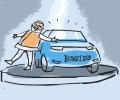
From Hyundai to Tata Motors, automakers are staring at a bleak future. With no succor provided in the Budget, the pain for companies is likely to continue for the next two quarters.
Here are the best selling cars in the month of October

Major automakers, including Maruti Suzuki, Hyundai, Tata Motors, Mahindra & Mahindra, Kia, Toyota and Honda, on Thursday reported healthy growth in passenger vehicles sales in June, recovering from the disruptions induced by the second wave of COVID-19. The country's largest carmaker Maruti Suzuki India (MSI) posted total sales of 1,47,368 units in June, up from 46,555 units in May. Its domestic dispatches to dealers last month stood at 130,348 units, up from 35,293 units in May, as easing of COVID-related restrictions helped the auto major to dispatch more units to dealerships.

These cars offer the performance of a more expensive car for a quarter of the price.

The new Scorpio came after a gap of 24 months since its last launch, during which the competition launched a slew of products.
Internet search giant Google tabulated the searches by consumers in India from January 2010 to May 2011.

According to government data, the Centre procured only 35,179 ventilators out of the 50,000 originally ordered.

Ford launches all-new Figo, price starts at Rs 4.29 lakh.

High ground clearance, a wide cabin and tall stance all mean that the Carens glides over bad roads with ease and comfort and an engine performance that is adequate in terms of the power of this vehicle, says Pavan Lall.

The price differential has been upwards of 20%.
Some of the most popular small cars sold in India, including Maruti Alto 800, Tata Nano, Ford Figo, Hyundai i10 and Volkswagen Polo, have failed crash tests showing high risk of life-threatening injuries in road accidents, according to Global NCAP.

With fast changing mentality of the crowd here, the automakers are creating their own categories to attract more and more buyers.

Maruti has plans to rev up sales of the Dzire, India's fourth most-sold car, by relaunching it.

Price is no longer king. Maruti now has a new strategy to score over rivals.
Leading automakers Maruti Suzuki India, Hyundai Motor, Kia Motors and Tata Motors reported sales growth in the domestic market in November, aided by robust offtakes amid the festival season. While Maruti Suzuki India reported marginal growth, Hyundai logged in its highest ever monthly sales in November. Others like Honda Cars India, Toyota Kirloskar Motor, Mahindra & Mahindra and MG Motor India also reported sales growth in November as compared with the same month last year.
India's second-biggest carmaker Hyundai Motor India Ltd on Wednesday raised prices of its two models while market leader Maruti and Czech car firm Skoda announced plans to follow suit next month to meet the rise in input costs and new emission norms.

Dealers have stocked up vehicles in the run-up to a price hike, which is expected to be announced by leading players some time this month.

Nissan and Renault say they will compete with new models, especially small cars, and by growing their dealer network.

The electric vehicle evolution in India's passenger vehicle market has remained frozen in time and may see limited adoption over the next decade, experts say.

Close to 60 per cent models that Kia sells in India are top trims of the models. In line with its global strategy, the India arm of South Korean major Kia has dropped 'Motors' from its name. This is to reflect the transition from an automaker to a provider of advanced and eco-friendly mobility solutions, the company said. With a new brand identity and slogan, the fourth-largest car maker in India by sales aims to accelerate growth and strengthen its premium positioning.

Young buyers willing to frequently replace older models with newer ones are boosting bookings and sales.

Car makers see a dip in demand from their biggest buyers, Ola and Uber. Demand from aggregators weakened for a number of reasons after a strong growth last year.
Cyrus Mistry in his second appearance as chairman of Tata Motors tried to reassure shareholders that steps were being taken to regain market share in both cars and trucks.

First-time buyers of cars and sport utility vehicles (SUVs) have made a comeback, shows last year's data from top passenger vehicle (PV) makers. If the trend persists, it may move the needle on the overall car penetration ratio. India's car penetration ratio is 32 per 1,000 people - one of the lowest, compared to mature car markets like the US and Europe.

Recently, TPEM's first born electric concept, Avinya broke cover. The model promises a minimum range of 500 kilometres and advanced technology features, aimed at buyers in India and outside. TPEM, the newly formed entity may also consider a separate dedicated sales channel for the EVs with a distinctive corporate identity once the volumes reach a critical mass and throughput is large enough for the dealers to be profitable, said Chandra. Elaborating further on the hiring strategy he said, "We will hire from everywhere-wherever the talent of the required competency is available."
Cars have just got dearer with major automobile firms, including Maruti Suzuki India, Hyundai and General Motors, increasing prices this month in order to offset rising input costs.
 © 2026 Rediff.com - Advertise with us - Disclaimer - Privacy Policy - Sitemap - Feedback - About us - Terms of use - Grievances